Rarity & Values
What drives value, the price guide, and the rarity scale for over 200 makers.
What drives the price
As of late 2024, prices for these daggers continue to rise. Condition always comes first: the blade (cross-grain showing, age greying or spotting, pitting, rust spots), the grip (chips, cracks, fit to the crossguards), a damaged tang nut, matching patina, the scabbard finish, a squashed or split scabbard ball, whether a hanger is present, nickel fittings versus plated RZM, a parts dagger versus an untouched original, unit markings or personalisation — and of course the rarity of the maker.
Location matters too. The USA has a vast number of daggers on the market and tends to set the benchmark. Europe has a large collectors’ market and prices are generally higher. The UK and Australia have far fewer daggers available, so prices are generally higher still. In June 2024 Australia banned the import and export of items bearing the swastika or SS runes, which has only pushed the trade underground and raised prices. Today most sales happen through search engines, social media groups, forums, auction houses, second-hand selling platforms, dealers and private websites.
Price guide
The guide below gives average prices from realised auction sales, dealer websites and similar sources, in US dollars, as of 2025.
| Type | Bad condition | Fair condition | Excellent condition | Mint / rare |
|---|---|---|---|---|
| Early / transitional | $400–600 | $700–900 | $1,000–1,500 | $1,500+ |
| RZM | $300–400 | $500–700 | $800–1,100 | $1,200+ |
| Ground Röhm | $700–900 | $1,000–1,400 | $1,500–1,800 | $2,000+ |
| Full Röhm | $2,500–3,500 | $4,000–6,000 | $7,000–9,000 | $10,000+ |
| Chained | $2,000–3,000 | $3,000–5,000 | $5,000–8,000 | $12,000+ |
| High leader | – | – | $30,000–40,000 | $50,000+ |
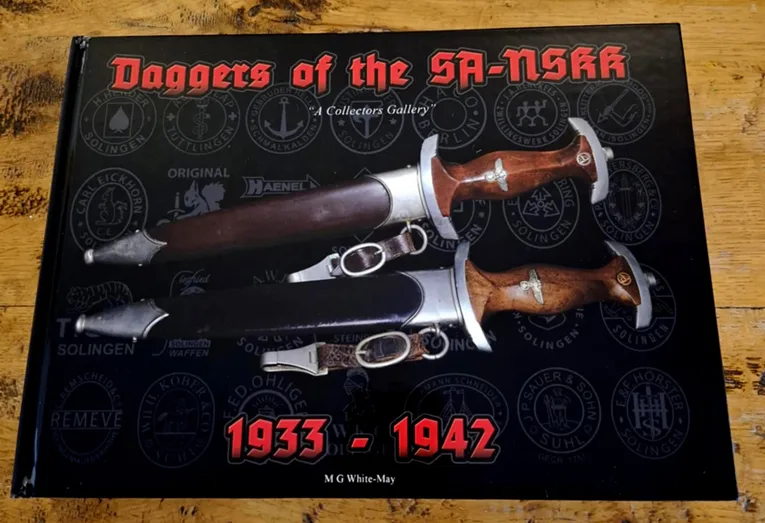
Indicative values from the book. Market prices change; always verify with recent sales.
Rarity scale by maker
The rarity scale is based on approximate production numbers for early-period daggers and on how often each maker is seen, compiled by the author with the help of fellow collectors. Production figures are estimates.
1/5 Common Estimated production 16,000–25,000+
- August Bickel
- F. Dick
- Carl Eickhorn
- C.G. Haenel
- Gebrüder Heller
- F. Herder
- Wilhelm Kober & Co
- Lauterjung & Sohn
- Malsch & Ambronn
- Ernst Pack & Söhne
- J.P. Sauer & Sohn
- Anton Wingen Jr
2/5 Uncommon Estimated production 11,000–15,000
- Aesculap
- Haco
- Hammesfahr & Cie
- J.A. Henckels
- Hermann Konejung A.G.
- Carl Julius Krebs
- August Merten Ww
- Gottfried Müller
- Carl Wüsthof
3/5 Scarce Estimated production 6,000–10,000
- FW Backhaus
- Fritz Barthelmes
- Gebrüder Bell
- Gebrüder Böhme
- Böntgen & Sabin
- Christianswerk
- C. Eppenstein & Söhne
- Gebrüder Grafrath
- Gustav Haker
- Herbertz & Meurer
- H. Herder
- E & F Hörster
- Kaufmann & Söhne
- Friedrich V.D. Kohlen
- Hugo Koller
- Gebrüder Krusius
- Lauterjung & Co
- Hugo Linder C. W. & Sohn
- Müller & Schmidt
- Carl Schmidt & Sohn A.G.
- Artur Schüttelhöfer & Co.
- Paul Seilheimer
- C. Gustav Spitzer
- Stöcker & Co. SMF
- Adolf Völker
- Wagner & Lange
4/5 Rare Estimated production 2,000–5,000
- Richard Balk & Söhne
- Eduard Becker
- Gebrüder Becker
- Gebrüder Berns
- Hugo Berns
- Julius Bodenstein
- Gebrüder Born
- Justus Brenger
- Ewald Cleff
- Clemen & Jung
- Albert Dorschel
- Paul Ebel
- Gustav Felix
- Eduard Gembruch
- Robert Giersch
- Giesen und Forsthoff
- Ernst Grah
- R. Haastert & Bull
- Carl Heidelberg
- Henkel & Müller
- Paul Henckels
- Herbeck & Mayer
- Robert Herder
- Gottfried Hoppe & Söhne
- Klittermann Haan & Moog
- Peter Daniel Krebs
- Gebrüder Krumm
- Kupper & Oertling
- H & F Lauterjung
- Johann Leupold
- C & R Linder
- Carl Linder
- Peter Lungstrass
- E. Lüttges & Co
- August Malsch Fr. & Sohn
- Karl Malsch-Spitzer
- May & vom Hau
- Carl August Meis GmbH
- Kuno Meisenburg
- Melzer & Feller
- August Müller
- Robert Müller & Sohn
- Josef Münch
- Neidhardt & Schmidt
- Ferdinand Neuhaus
- F. Ed. Ohliger
- Julius Ohliger
- Daniel Peres
- Hugo Räder
- Kuno Ritter
- J.A. Schmidt & Söhne
- Friedrich August Schmitz
- Albrecht Schnittert
- Otto Simon
- Solinger Axt und Hauerfabrik
- Johann Spalteneder
- Franz Steinhoff
- Süddeutsche Messerfabrik
- Carl Tillmanns & Söhne
- Eduard Vitting
- Emil Voos
- Weyersberg Kirschbaum & Cie WKC
- Weyersberg Max Waffenfabrik
- Paul Weyersberg & Co
- Reinhard Weyersberg
- Arthur Wingen
- Gustav Wirth
5/5 Very rare Estimated production under 1,000
- Julius Bahrl Jr.
- Carl Bender
- Karl Böcker
- Böker
- E. Bonsmann
- F. Von Brosy
- Ernst Bruckmann
- Rudolph Büschel
- Ernst Busch
- Otto Curdts
- Ernst Dirlam
- Dirlam & Söhne
- J. E. Dittert
- Rich Drees & Sohn
- Eickelnberg & Mack
- Arthur Evertz
- Franz Frenzel
- Friedrich Geigis
- Ernst Gerling
- Emil Gierling
- Carl Grah
- Reinhold Grah
- Ludwig Groten
- Carl Haas
- Eugen Haering
- Hermann Hahn
- Carl Halbach
- Hartkopf & Co
- Richard Hartkopf
- F & A Helbig
- Herder & Engels
- Herder & Sohn
- Herder & Co
- Rich Abr Herder
- F. W. Höller
- Curt Hoppe
- Wilhelm Hoppe
- Jacobs & Co
- C. Rudolf Jacobs
- F. W. Jordan
- Emil Kaiser & Co
- Max Kaiser
- Karl R Kaldenbach
- C F Kayser
- Ernst Kemper
- F A Kirschbaum & Co.
- Robert Klass
- Carl Kloos
- August Knecht
- E. Kneckt & Co
- Koch & Rau
- Koeller F. & Co
- Paul Kohl
- G. L. Koller
- Heinrich Krom
- Carl Friedrich Kuhrt
- August Kullenberg
- Hermann Linder & Söhne
- Hugo Linder
- Otto Linder
- P.D. Lüneschloss
- C. Lütters & Cie
- David Malsch
- Karl Malsch Gustav & Sohn
- Ernst Mandewirth
- Albert Mebus
- Artur Melcher
- Gustav Neeff
- Louis Perlmann
- Julius Pilz
- Friedrich Plücker Jr.
- Richard Plümacher & Sohn
- Ernst Hugo Rasspe
- Erhardt Reich
- Cuno Remscheid
- Josef Reuleaux
- Ernst Römer
- August Rother
- Ernst Röttgen
- Carl D Schaaff
- Wilhelm Halbach
- Carl Schlieper
- Josef Schlimbach
- J. Schmidt & Söhne
- Rudolf Schmidt
- Hermann Schneider
- Emil Schrick & Sohn
- Hugo Servatius
- E. Spitzer
- Otto Stöver
- Karl Tiegel
- Gebrüder Torley
- Gustav Voss
- Wilhelm Wagner
- Wilhelm Weltersbach
- A. Werth
- Wester & Butz
- Gebrüder Weyersberg
- Gottfried Weyersberg & Söhne
- Gustav Weyersberg
- Thomas Wielputz
- Ernst Erich Witte
- Josef Wolf
- Is Wolfertz
- Ed Wüsthof
- Carl Zander
- Ludwig Zeitler
Daggers of the SA-NSKK 1933–1942, rarity scale tables. Quantities are estimated production totals. Linked names have a maker page on this site.