History
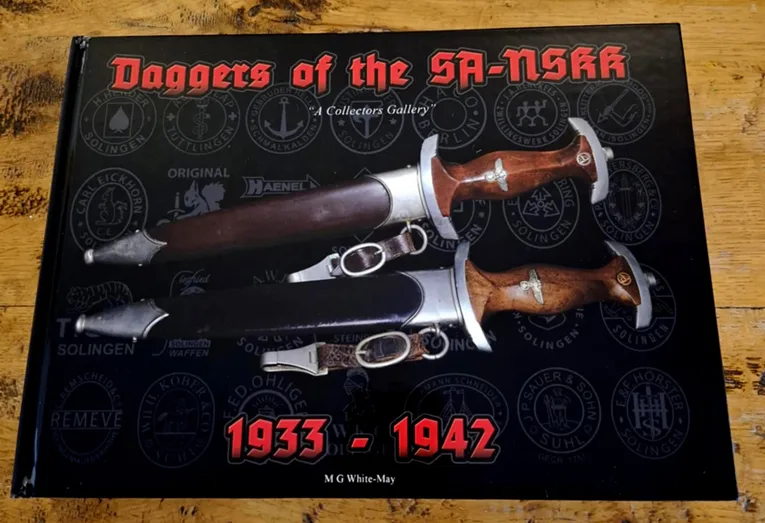
From the Swiss Holbein dagger to the SA and NSKK service daggers of 1933–1942, and the firms and towns that made them.
Origin: the Swiss dagger
The SA, NSKK and SS daggers are based on a 13th-century Swiss dagger. Its defining marks are two crescent-shaped, inward-bent metal bars limiting the hilt, and the curved shape of the hilt. The blade often had a diamond-shaped cross-section, was double-edged and tapered to a sharp point.
The Sturmabteilung
The term “Sturmabteilung” (storm division, or storm troopers) predates the Nazi Party. It was first applied to the specialised assault troops of Imperial Germany in World War I, using infiltration tactics by small squads. The first stormtrooper unit was authorised on 2 March 1915 for the Western Front, and on 2 October 1916 Ludendorff ordered every German army in the west to form a stormtrooper battalion. They proved their effectiveness at Riga and Caporetto, and in the Spring Offensive of March 1918.
The SA
The SA was the original paramilitary wing of the Nazi Party and played a significant role in Hitler’s rise to power in the 1920s and early 1930s. Its purposes were protecting Nazi rallies and meetings, disrupting meetings of opposing parties and fighting their paramilitary units. Distrust of the SA led Hitler to create a separate bodyguard in 1925, which became the SS.
The NSKK
The Nationalsozialistisches Kraftfahrkorps (NSKK) was a paramilitary organisation of the Nazi Party from May 1931 to 1945, succeeding the National Socialist Automobile Corps (NSAK) of 1930. It trained members to operate and maintain motorcycles and cars, transported party and SA members, and served as a roadside assistance group in the mid-1930s. It was the smallest of the party organisations, and no prior motoring knowledge was needed to join.
The “Christmas dagger”
The December 1933 model, with the early SA eagle and motto, is known to collectors as the Weihnachtsdolch or “Christmas dagger”. Only a small number were made — estimated at 50 to 100 — and given to high-ranking members in December 1933 and January 1934, before the dagger became part of standard SA dress. All had the Röhm dedication, and about 30 survive in private collections. Known examples were made by Eickhorn and E. Pack & Söhne, in three variants: Eickhorn with the early grip eagle and early logo; Eickhorn with the standard grip eagle and double-oval logo (both SA and NSKK); and Pack with the early eagle and motto.
Röhm honour daggers
On 3 February 1934 Ernst Röhm introduced an honour dagger bearing a facsimile of his handwritten inscription “In herzlicher Kameradschaft, Ernst Röhm” (in cordial comradeship). All SA members who had joined before 31 December 1931 were entitled to wear it, and approximately 125,000 were produced and awarded.
- Full Röhm: the inscription complete and untouched, as issued.
- Partial or “lazy man’s” Röhm: the name or part of the inscription removed.
- Ground Röhm: the whole inscription removed, by hand or properly ground and re-polished at the factory.
SA Gruppe orders, 1934
| SA Gruppe | Daggers ordered |
|---|---|
| Berlin-Brandenburg | 8,300 |
| Bayerische Ostmark | 3,200 |
| Franken | 4,100 |
| Hansa | 3,000 |
| Hessen | 5,500 |
| Hochland | 6,100 |
| Mitte | 6,000 |
| Niederrhein | 8,500 |
| Niedersachsen | 6,100 |
| Nordmark | 4,600 |
| Nordsee | 4,100 |
| Österreich | 3,200 |
| Ostland | 6,100 |
| Ostmark | 4,500 |
| Pommern | 5,700 |
| Sachsen | 7,900 |
| Schlesien | 8,700 |
| Südwest | 7,900 |
| Thüringen | 4,800 |
| Westmark | 7,800 |
| Westfalen | 9,700 |
M36 chained daggers
In 1936 the SS and NSKK both introduced chained daggers. The SS was by now an independent and powerful organisation, and the NSKK had also broken away from the SA and had close ties to the SS. The M36 NSKK chained leader’s dagger was for NSKK-Sturmführer (second lieutenant) and above. The chain came in two variants, with 3 & 5 or 4 & 5 links, and retail sale by uniform shops was not allowed. It is not known why the SA never introduced a chained officer’s version; senior members already had the chained high leader dagger.
SA high leader daggers
Made by Eickhorn, the SA high leader dagger has ornate handcrafted crossguards, a “maiden hair” Damascus blade with raised gilt etch, and a leather-bound chained scabbard. They are very rare and sell for in excess of US $50,000.
Blade manufacturers
From the early 1930s to 1945, 262 manufacturers produced edged weapons for the Third Reich. Some were large, well-established firms; many were small family operations working from tiny sheds or small factories, some still using water wheels. Larger firms are known to have supplied parts and fittings to the smaller cottage makers. Very little information, photographs or records survive for most of the small makers. In the hard post-war years, with cities bombed, factories dismantled or moved as reparations and millions of German prisoners used as forced labour, most of the small cottage makers simply ceased to exist. Some of the larger companies survive today.
Solingen, “City of Blades”
Solingen has been the centre of the German weapon and cutlery industry since the Middle Ages. Its rivers and streams powered drop hammers and grinding machines, and the trading city of Cologne was close by. A guild was formed in the 15th century, and the name “Solingen” became a worldwide mark of quality, carried on blades alongside each maker’s own mark.
Thuringia
The Free State of Thuringia, about 350 km east of Solingen, was a hub for bladesmiths from 1930 to 1945. Approximately 215,000 daggers were made by 28 makers in the region, and some of them made only early daggers and never had an RZM code.
- Steinbach: Julius Bodenstein 3,000; Otto Simon 3,000; Karl Malsch-Spitzer 2,000; Karl Malsch & Sohn 1,000; David Malsch 1,000; Malsch & Ambronn 12,000; F. & A. Helbig 1,000; August Malsch & Sohn 2,000.
- Schweina: Erhardt Reich 1,000.
- Brotterode: Neidhardt & Schmidt 4,000; Gebrüder Böhme Nachf. 6,000; Karl Fr. Kuhrt 1,000; Josef Münch 2,000.
- Herges-Vogtei: Gottfried Müller 12,000.
- Schmalkalden: Gebrüder Heller 46,000; Adolf Völker 6,000.
- Steinbach-Hallenberg: August Bickel 24,000.
- Zella-Mehlis: Melzer & Feller 4,000.
- Suhl: Wilhelm Kober 35,000; J.P. Sauer 23,000; C.G. Haenel 25,000.
Suhl and the “Suhl step”
The old mountain town of Suhl was a major producer of cannon and arms from the 17th century onwards, and home to J.P. Sauer & Sohn, C.G. Haenel and Simson. A training institute for military gunsmiths opened in 1840, and around 12,000 people worked in the Suhl arms industry in World War I.
Steinbach
Trade and industry shaped Steinbach’s history. Cutlers, locksmiths and miners lived in the village, mostly in small one-man businesses; in the mid-19th century 130 cutlers and 80 locksmiths made 130,000 dozen knives and 100,000 locks a year. Steinbach’s dagger makers included Julius Bodenstein, Otto Simon, F. & A. Helbig and five firms bearing the name Malsch — August Malsch Friedrich & Sohn, David Malsch, Karl Malsch-Gustav & Sohn, Malsch & Ambronn and Carl Malsch-Spitzer. All but Malsch & Ambronn were small cottage makers producing only 1,000 to 2,000 daggers each.
Paul Casberg, designer
Paul Casberg (1883–1946) was a Berlin graphic artist highly regarded for his knowledge of uniforms, insignia and decorations, working for ministries, the armed forces and party organisations. He designed new Wehrmacht standards that kept the link with Germany’s older flags. In 1934 Carl Eickhorn hired him as its leading designer: he created Eickhorn’s new logo and catalogue and designed numerous edged weapons, gorgets, belt buckles and badges, as well as the insignia, flags and uniform elements of the RAD and TeNo. In 1935 he designed the wedding sword presented to Hermann Göring.