Anatomy & manufacture
Anatomy & Manufacture
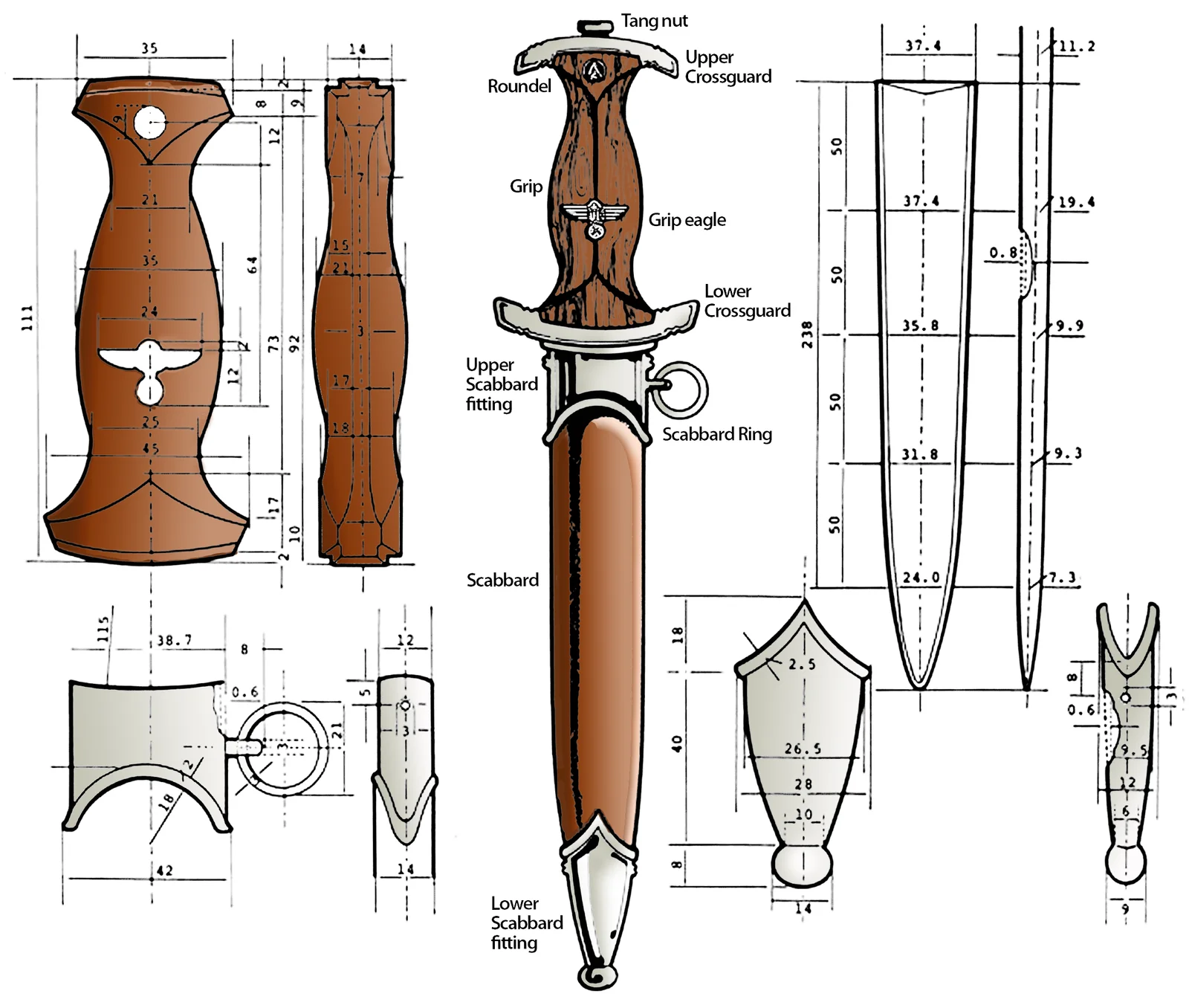
Select a part on the drawing to see what it is and what to look for, then read how each part was made.
-
Screws onto the threaded end of the tang and clamps the grip between the crossguards. Nickel on early daggers. Plier marks or a rounded knuckle suggest the dagger has been taken apart.
-
63 mm wide, with a round hole for the tang. Cast nickel silver on early daggers; zinc, pot metal or aluminium, copper-washed and plated, on late ones. Most are cast-marked inside with the maker’s initials, such as “P.A.” (Piel & Adey).
-
An 8 mm enamelled badge in shades from light to dark brown. Makers differ: on some the arrow stands clear of the circle, on others it blends in.
-
106 mm long; hardwood (maple, pear, nut, beech or oak) from light blonde to dark brown. Early grips are rounder and hand-finished; late RZM grips have a sharper centre ridge.
-
24 × 14 mm, die-struck, held by two prongs bent over inside the grip. Solid nickel silver early, aluminium or silver-washed zinc later. Necks, heads, chests and swastikas vary between suppliers.
-
77 mm wide. On early daggers the reverse is usually hand-stamped with the SA Gruppe mark (for example “Nrh” or “Wf”); the stamping stopped in the RZM period. Some Eickhorns also carry a small bench number.
-
220 mm long, double-edged forged carbon steel. The motto “Alles für Deutschland” is acid-etched in the Maximilian Fraktur typeface on one side; the maker’s mark, or later the RZM M7 code, on the other.
-
The throat of the scabbard, carrying the ring. Nickel on early scabbards, plated steel or zinc later.
-
21 mm ring for the short leather loop hanger; from April 1935 a three-piece hanger kept the dagger steady when marching. NSKK leaders’ M36 daggers hang from chains.
-
249 mm; two steel or copper shells with a counterweight so the dagger hangs at about 45 degrees. Brown anodised and lacquered early, then painted; NSKK scabbards were black from 1936, often painted over brown by hand.
-
The chape protecting the tip, ending in a ball. Check that it matches the upper fitting, and look for a squashed or split ball.
Specifications
| Total length | 375 mm |
|---|---|
| Blade length | 220 mm |
| Blade width | 32.8 mm |
| Blade depth (thickest point) | 5.2 mm |
| Upper crossguard | 63 mm |
| Lower crossguard | 77 mm |
| Grip length | 106 mm |
| Grip width (upper / centre / lower) | 35 / 35 / 45 mm |
| Grip roundel | 8 mm |
| Grip eagle (width × height) | 24 × 14 mm |
| Scabbard length | 249 mm |
| Scabbard width | 40.6 mm |
| Scabbard ring | 21 mm |
| Total weight (scabbard on, no hanger) | 460 g |
Production periods
Early period, 1933–1935
After the decision to award daggers to SA members on a mass scale, production of the revised pattern began in February 1934, correcting flaws found in the first batches. The scabbard, which deformed too easily, was changed; the eagle was replaced with an easier-to-fit round-top eagle; and the motto’s typeface was changed. The first-batch motto was probably hand drawn by one maker’s etch master, as no matching typeface is known. Complaints about the first batch were so serious that in May 1934 an order was issued to replace those daggers.
Mid period, 1936–1938
Mid-period or “transitional” daggers kept an overall high-quality finish, but production was now controlled by the RZM. Group marks on crossguards stopped, and RZM contract codes were required on the blade; some makers kept their own mark above or below the code, and 1939-dated double-marked blades exist. Aluminium grip eagles started to appear, and many firms used early-type fittings still in stock.
Late period, 1939–1942
Late or “RZM” daggers are found from 1938 onwards. Nickel-silver fittings gave way to nickel-plated zinc alloy, cast iron and even aluminium, and all grip eagles were aluminium. Grips had harder, sharper lines, less care went into the fit of grip, crossguards and eagle, the blade’s centre ridge became more pronounced and motto etching declined. Maker marks were no longer permitted, only the RZM code. As raw materials were needed for armaments, the manufacture of all swords and daggers ceased in 1942.
The motto and its typeface
The motto is a blackletter Fraktur typeface, long regarded as the true German script. The SA and SS blade mottos used “Maximilian”, designed in 1913–14 by Rudolf Koch and published in 1917 by the Gebr. Klingspor type foundry, with subtle changes to the capital A and D and the lowercase s and f.
Blade etching
The motto, maker mark and RZM code were acid-etched. The blade was covered with an acid-resistant wax ground, the design was exposed, and the blade was dipped in an acid bath (the mordant). As the steel etches it turns from shiny to matte, light silver to grey and finally black, depending on the steel, temperature and acid strength. The master artwork was drawn large by a calligrapher, photo-reduced and used to make wax templates. All mottos look alike at first glance, but close inspection shows small differences in the size and weight of certain letters.
The SA roundel
The roundel is an enamelled badge 8 mm wide, in shades from light to dark brown, and each maker’s insignia differs slightly — on some the arrow stands clearly apart from the circle, on others it blends in. The SA symbol came from a 1929 competition: it combines the Sig rune (lightning) with the Mann rune, joined by a ring, arranged so that the letters S and A can be read, with a tick added to strengthen the A. It was designed by Hans Zöberlin and Max Zankl.
The grip
Grips were hardwood — maple, pear, nut, beech or oak — in colours from light blonde to dark brown; some plain, others with beautiful natural grain. Early grips were handcrafted and hand-finished during assembly, with tightly fitted crossguards and close tolerances around the roundel and eagle. Early grips look more rounded; late grips have a sharper centre ridge.
The grip eagle
Grip eagles were die-struck with two flat prongs on the back. The eagle was set into a machine-cut recess and secured by bending the prongs. Several makers supplied slightly different eagles, varying in the neck, head, chest and the size and thickness of the swastika. Early eagles were solid nickel silver; transitional daggers have nickel or solid aluminium, silver-washed; late eagles were zinc-based and silver-washed. Some show a copper colour where the silver wash has worn through to a copper coating beneath.
Crossguards
The smaller upper crossguard has a round hole for the tang and nut, the larger lower crossguard a small rectangular slot, sometimes with a recess for the blade. Both are boat-shaped, recessed for the grip and have two deep accent lines on each side. Many firms made and supplied crossguards, and most are cast-marked inside with the maker’s initials — “P.A.” (Piel & Adey) is common, and others include AD, AE, AL, B, BC, D, EL, EW, FB, H, HE, K, K8, PS, WW, 8A and 3085. Eickhorn, Pack, Haco and the Suhl makers can be recognised by their crossguards alone.
The scabbard
The scabbard has two outer shells of copper or thin steel plate, an upper fitting (Stiefel), a lower fitting (Tülle), an internal runner and a counterweight so the dagger hangs at about 45 degrees. SA scabbards vary from light copper-brown to dark brown. Early scabbards had nickel fittings and were anodised and lacquered; painted scabbards followed, with solid nickel or later plated steel fittings, and some late RZM daggers have plated zinc fittings. In 1936 the NSKK ordered its members to use black scabbards; many simply painted over the brown anodising by hand, and later NSKK daggers were factory-painted black.
Hangers
The standard hanger was a short brown leather loop with an oval buckle and spring clip; early hangers had nickel fittings and short- or long-nose clips, and later ones were plated with an RZM-marked strap. In April 1935 an extra snap-clip loop on a belt hanger was introduced to keep the dagger vertical when marching — known to collectors as the three-piece hanger. A vertical hanger was also approved and is found on some SA/NSKK daggers, though it is more often seen on SS daggers.
SA group marks
Group marks were a distribution control: two or three small letters hand-stamped on the reverse of the lower crossguard, showing the SA Gruppe the dagger was sent to. Some early daggers have no group mark — private purchases, or daggers issued after the marks were discontinued.
- B Berlin-Brandenburg
- BO Bayerische Ostmark
- Fr Franken
- Ha Hansa
- He Hessen
- Ho Hochland
- Mi Mitte
- Nm Nordmark
- No Nordsee
- Nrh Niederrhein
- Ns Niedersachsen
- Oe Österreich (Austria)
- Om Ostmark
- Ost Ostland
- P Pommern
- S Schlesien
- Sa Sachsen
- Sw Südwest
- Th Thüringen
- Wf Westfalen
- Wm Westmark
- W Feldherrnhalle
What collectors have recorded
- The makers did not stamp the marks. Daggers were delivered to the SA district, and the lower crossguards were stamped on arrival.
- Hochland (“Ho”) is the only Gruppe known to have stamped its mark off-centre, near the accent grooves of the crossguard.
- A “double hit” — the letters struck twice — is normal: the first blow found the mark and the second applied the lettering.
- Rarely, a genuine early dagger with nickel-silver crossguards has no Gruppe mark, possibly an overage sent to a district. A missing mark alone does not make a dagger wrong.
- After 1935 the marks disappeared as the RZM took control. An early Gruppe-marked crossguard on a mid or late period dagger may be wartime use of old parts, a post-war “put together”, or something more recent.
- “Oe” (Österreich) appears on the Gruppe map, but the Austrian SA was banned in the early 1930s and hidden under “Nordwest Hilfswerk” until the Anschluss of 1938; no “Nw” marks are known on SA daggers.
- “W” (Feldherrnhalle) shared the Hochland district around Munich. Only a very small number of daggers with this mark are known.
- The Gruppen Alpenland (A), Donau (Do), Kurpfalz (Kp), Südmark (Sm) and Sudetenland (Su) were formed after 1938, when marking had already stopped, so no daggers with these marks are known.
Each maker page lists the Gruppe marks recorded on that maker’s daggers, combining the book with a collectors’ forum list of sightings (credits: forum administrator Adrian Stevenson, Ian Dale of Simply Daggers, and member “Degens”).
RZM contract codes
The Reichszeugmeisterei (RZM) in Munich was the national material-control office for party uniforms and equipment, replacing the SA’s own purchasing office. From 1934 it set the design, specifications and quality standards for all uniforms and equipment; by July 1934 there were over 15,000 licensed factories. Every item had to carry the RZM symbol and a number showing the sector, material group, maker and year. Metal items used the prefix M, and the M7 code was used only on political daggers, not military ones — army, navy and air force edged weapons kept their makers’ logos until production ended in 1942.
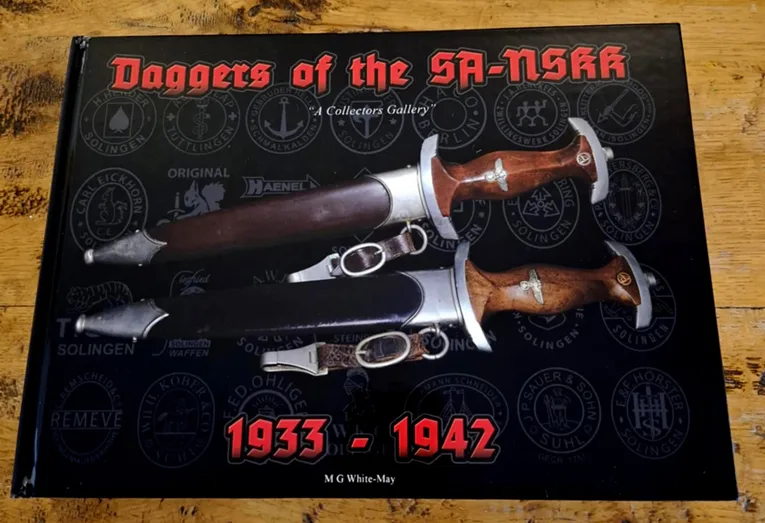
Daggers of the SA-NSKK 1933–1942, and the forum post "RZM code 7 / dagger makers names" by 85ronnies (2015). RZM M7 codes were used only on political daggers. Codes from M7/163 upwards are found on 1933-pattern SS daggers; that part of the list is not complete. Linked names have a maker page on this site.
SS dagger contract codes
SS daggers carried their own contract codes, in the form number/year SS — for example “941/38 SS” for Carl Eickhorn in 1938. The list below shows the codes recorded so far; some makers have not yet been identified.
SS Dienstdolch contract codes compiled by Paul ("Lakesidetrader"), from the forum post "RZM code 7 / dagger makers names" by 85ronnies (2015). Blank entries are codes whose maker has not been identified. Linked names have a maker page on this site.